Welcome to Christian Council of Nigeria (CCN)

Phone
Visit
24, Douala Crescent, Wuse Zone 5, Abuja, FCT.
Welcome to Christian Council of Nigeria (CCN)
24, Douala Crescent, Wuse Zone 5, Abuja, FCT.


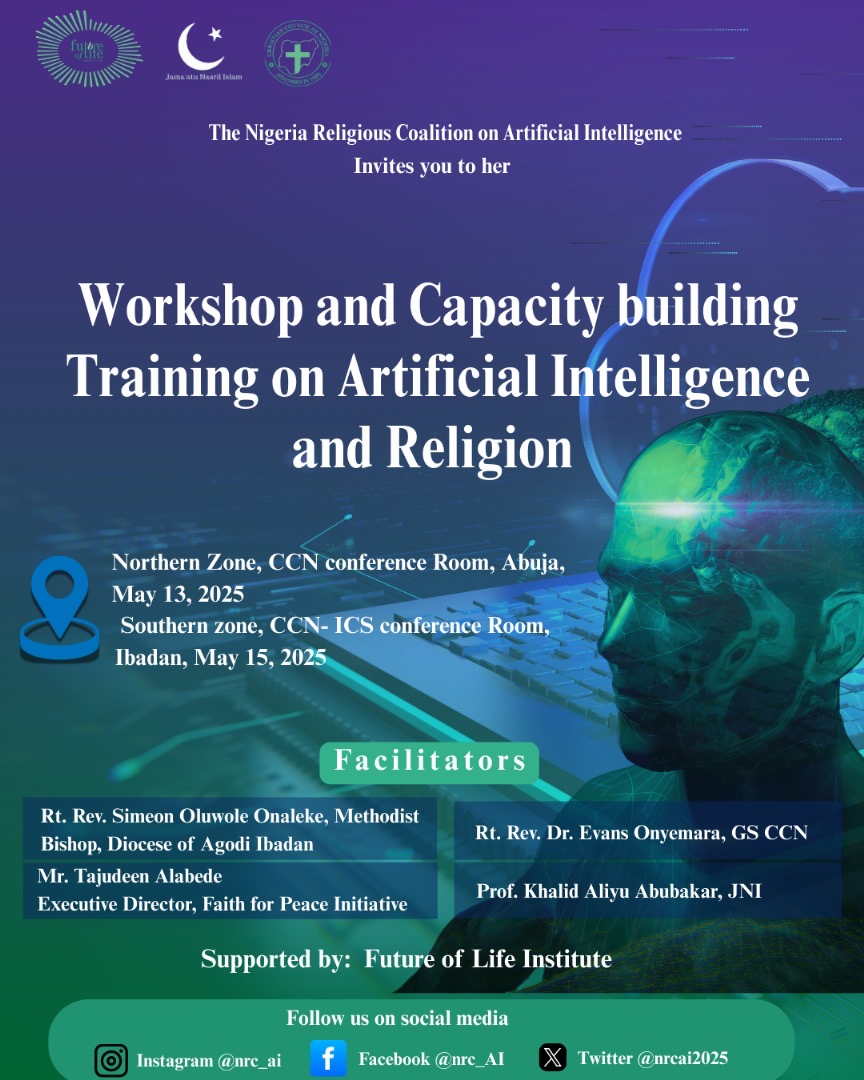
Nigeria’s foremost Christian and Islamic institutions have sounded an urgent alarm over the unchecked rise of Artificial Intelligence (AI), warning that it threatens to erode religious values, human dignity, and moral consciousness if not urgently guided by ethical frameworks. At a high-level press briefing held on Tuesday, April 15, 2025, in Ikeja, Lagos, the Nigeria Religious Coalition on Artificial Intelligence—comprising the Christian Council of Nigeria (CCN), the Institute of Church and Society (CCN-ICS), and Jama’atu Nasril Islam (JNI)—warned that AI could subtly evolve into a tool of spiritual deception.
Rt. Rev. E. Oluyinka Akande, Bishop of the Diocese of Lagos West, Methodist Church Nigeria, delivered a fiery keynote, declaring that humanity is at a crossroads where technological evolution must not be allowed to outrun theological and ethical responsibility. “AI is here to stay, but it cannot replace God,” he cautioned. “If we fail to shape AI with divine values, it will reshape us in godless ways.” He referenced growing global concern about Artificial General Intelligence (AGI), echoing sentiments expressed in recent EU and UN ethics forums about the dangers of autonomous systems that operate without human oversight.

Religious leaders emphasized that the principle of Imago Dei—that humans are created in the image of God—must remain sacred. Bishop Akande warned that AI, when granted too much autonomy, risks elevating machines to a pseudo-divine status. “Should machines begin to imitate or influence human spirituality, it’s not advancement—it’s idolatry,” he said. He urged that AI must never be allowed to assume roles that demand human discernment, empathy, or divine guidance. “No line should be blurred when it comes to our spiritual identity,” he added.
JNI representatives at the event echoed the urgency, warning that AI could be manipulated to spread disinformation, especially in volatile religious settings. With over 84% of the global population identifying with a religion, they argued it is irresponsible to allow the development of systems that ignore religious morality. “Tech giants and developers must include faith-based institutions in shaping AI frameworks,” JNI said, while supporting calls for Nigeria to spearhead a continental AI Ethics Charter rooted in both Islamic and Christian principles.
The coalition revealed plans for a nationwide sensitization campaign spanning Lagos, Kaduna, and Abuja, aimed at collecting feedback from clergy, scholars, and followers of both faiths. The year-long program, supported by the U.S.-based Future of Life Institute, seeks to produce a national policy document on ethical AI deployment. “Our job is to engage, not to resist innovation,” said CCN General Secretary Rt. Rev. Evans Onyemara. “We’ve submitted policy papers to the National Assembly in the past—this will be our most impactful yet.”
Akande added that religious communities must not fear technology but must be its moral compass. “We can’t be mere spectators. We must program the soul into AI—compassion, justice, dignity,” he said. He called for ethical AI integration in agriculture, health, and education, while opposing any AGI project that undermines human agency or faith-based decision-making. “It’s not a tech issue; it’s a spiritual survival issue,” he warned.
The coalition’s position is clear: AI must serve humanity, not rule over it. They urged developers to place ‘ethical speed bumps’ in AI design, including banning the development of godlike AGI models, protecting religious practices from algorithmic manipulation, and ensuring technology uplifts society’s moral fabric. “Technology may evolve faster than faith,” Akande concluded, “but if we don’t anchor that evolution in divine wisdom, we’re walking into a digital wilderness without a compass.”


The Christian Council of Nigeria (CCN) fosters unity, advocacy, and spiritual growth, promoting justice and inclusivity in Christian communities.

17 Jun, 2024
04 Aug, 2024

Leave a Reply