Welcome to Christian Council of Nigeria (CCN)

Phone
Visit
24, Douala Crescent, Wuse Zone 5, Abuja, FCT.
Welcome to Christian Council of Nigeria (CCN)
24, Douala Crescent, Wuse Zone 5, Abuja, FCT.

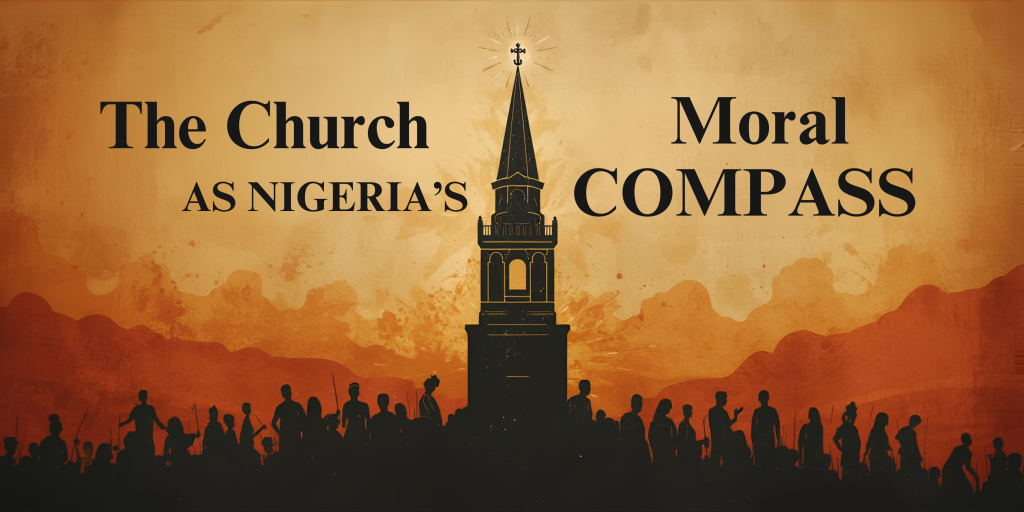
By The Rev. Uruakpa Onyemaechi Charles
Nigeria is not suffering from a shortage of talent or natural resources. It is struggling with something more elusive and more consequential: a crisis of moral direction.
Africa’s most populous nation stands at a delicate inflection point. Economic pressures weigh heavily on households. Youth unemployment fuels frustration. Public trust in institutions has eroded after years of corruption scandals, governance challenges and insecurity. National debate is vigorous, yet social cohesion remains fragile.
In moments like this, societies often search for political solutions alone. But history suggests that sustainable national renewal requires more than policy reform — it demands moral recalibration.
For Nigeria, that places a profound responsibility on one of its most influential institutions: the Church.
Christianity represents a significant portion of Nigeria’s population. Churches operate schools, hospitals, humanitarian networks and vast grassroots structures that reach deep into communities. Their influence extends well beyond Sunday services.
The American civil rights leader Martin Luther King Jr. once wrote that the Church is “not the master or the servant of the state, but the conscience of the state.” That description captures the delicate balance required in Nigeria today. The Church must neither seek political domination nor withdraw into spiritual isolation. Its role is moral clarity — rooted in justice, compassion and accountability.
When religious institutions speak consistently and act transparently, they shape national character. When they compromise, public cynicism deepens.
Yet the Church cannot call a nation to integrity without modeling it internally.
Across Nigeria, faith communities have done extraordinary work in poverty alleviation, peacebuilding and education. But like many powerful institutions, they are not immune to criticism — particularly around financial transparency, leadership accountability and the commercialization of religion.
Moral authority cannot be asserted; it must be earned.
If the Church is to function as a national compass, it must strengthen governance within its own structures, promote ethical stewardship of resources and demonstrate consistency between message and method.
Integrity is not merely theological — it is institutional.
Nigeria’s religious landscape is diverse, and Christian denominations are themselves numerous. Yet internal rivalry weakens collective impact.
In the Gospel of John, Jesus prayed “that they may be one.” While theological differences will persist, collaboration on social justice, anti-corruption advocacy and youth development could amplify moral influence.
Ecumenical cooperation is not about uniformity of doctrine; it is about unity of purpose.
In a polarized environment, visible unity among Christian leaders could send a powerful message that shared values transcend denominational boundaries.
Prayer remains central to religious life. But national transformation also requires practical engagement.
Church institutions can:
Religious voices carry weight in Nigeria. The question is not whether they influence public life, but how.
Silence in the face of injustice is often interpreted as acquiescence. Conversely, responsible engagement can help rebuild public trust.
Nigeria’s situation is not unique. Around the world, democracies wrestle with declining institutional trust and widening social divisions. Faith communities everywhere face a similar question: Will they retreat into ritual, or rise to moral leadership?
For Nigeria, the answer may prove especially consequential. With its youthful population and regional influence, the country’s trajectory matters far beyond its borders.
Economic reform is necessary. Political reform is essential. But without ethical reform, neither will endure.
If the Church in Nigeria chooses unity over rivalry, integrity over expediency and service over spectacle, it can help steady a nation searching for direction.
A compass does not eliminate the storm. It provides orientation within it.
Nigeria’s future may depend, in part, on whether its most influential moral institutions are willing to point north — consistently.
Leave a Reply